End-of-life vehicle (ELV) shells are one of the materials with relatively high metal enrichment in municipal solid waste. After standardized dismantling, removal of hazardous waste and reusable assemblies, the remaining vehicle shells still contain large amounts of steel, aluminum, copper, as well as a small amount of plastics and composite materials. Effectively dissociating and purifying these materials can not only provide substitute raw materials for steel mills and non-ferrous metal smelting enterprises, but also help recycling enterprises meet increasingly strict resource recovery rate requirements.
Recycling Value of End-of-Life Vehicle Shells
From a global perspective, the treatment volume of end-of-life vehicles continues to grow. In 2025, the total mass of end-of-life vehicles worldwide is about 68 million tons, of which recyclable materials account for more than 85%. At the regional level, Europe dismantles more than 6 million vehicles each year, and the EU ELV Directive requires that at least 95% by weight of each vehicle be recovered, of which 85% is actual recycling. Other major economies are also gradually tightening recovery rates and material closed-loop requirements for end-of-life vehicles.
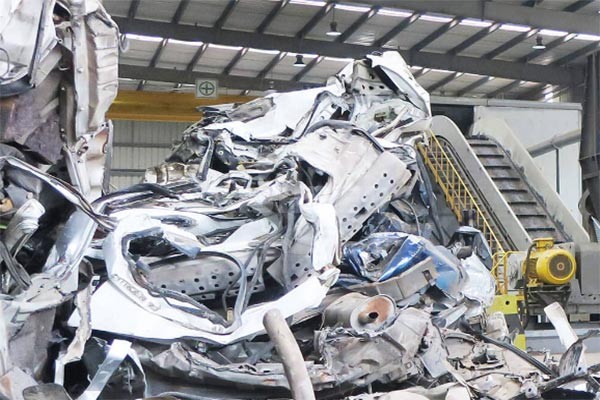
The material composition in vehicle shells determines the output structure of the recycling line. After fine processing, a small end-of-life vehicle can separate about 740 kg of scrap iron, 100 kg of aluminum, 70 kg of plastics and 36 kg of rubber. Steel is the bulk output of the recycling line, and aluminum and copper have higher unit values, but they are also more difficult to recover—they often exist in vehicle shells in the form of inlays, riveting or wiring harnesses, and require sufficient crushing dissociation to be effectively recovered by separation equipment. In recent years, the practice of high-end recycling projects shows that under optimized separation and process control conditions, the closed-loop recovery rate of steel can reach 81%, aluminum 52%, and copper 68%. This means that the separation accuracy of the recycling line directly determines the actual income of high-value materials.
Core Configuration of the Recycling Line
A complete end-of-life vehicle shell shredding and recycling line usually includes four links: pretreatment, shredding, separation and environmental protection supporting facilities. Before vehicle shells enter the shredding line, the removal of hazardous substances and reusable parts must be completed, including batteries, airbags, various oils, filters and other hazardous wastes, as well as engines, transmissions, three-way catalytic converters and other high-value assemblies. This step is the basis for ensuring the safety and environmental protection of the subsequent shredding process. The shredding stage is the core of the whole line. The current mature configuration adopts two-stage shredding and crushing: the double-shaft shredder is responsible for pre-shredding, and the hammer crusher completes final crushing and balling. The separation stage generally combines magnetic separation, eddy current separation and air separation to separate iron, non-ferrous metals and light impurities. Environmental protection supporting facilities cover dust removal and tail gas treatment to ensure that the production line meets local emission requirements.
In this configuration, the division of labor and coordination between the shredder and hammer crusher is the key to determining the capacity, energy consumption and maintenance cost of the whole line.
How the Shredder and Hammer Crusher Work Together
The advantage of hammer crusher lies in high-speed impact: the hammers strike the material into ball or clump shapes, causing paint, plastics and dirt on the metal surface to fall off, while increasing bulk density and producing crushed material directly acceptable to steel mills. Complete vehicle shells without pre-shredding are large in volume and irregular in shape. If they directly enter hammer crusher, two problems will arise: first, the feeding of hammer crusher is uneven, the rotor load fluctuates greatly, and instantaneous impact may cause abnormal wear of the hammers or screen; second, large hollow cavity structures in vehicle shells are difficult to be effectively struck inside the hammer crusher cavity, the residence time of materials in the machine is prolonged, and the energy consumption per unit output rises accordingly.
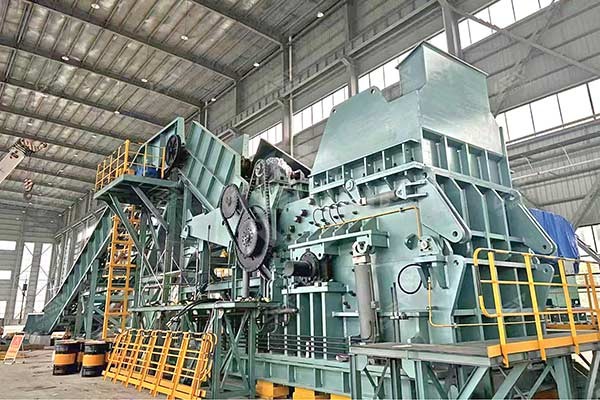
The double-shaft shredder solves exactly this problem. It replaces high-speed impact with low-speed high-torque shearing, and the knife teeth rotate toward each other, tearing vehicle shells into strip-like or block-like materials with relatively uniform size, creating three conditions for hammer crusher:
Uniform feeding, allowing hammer crusher to operate under stable load. When vehicle shells without pre-shredding enter hammer crusher, the load fluctuates sharply, and working conditions of "one feed overload, one feed idling" are likely to occur. After shredding, the material size tends to be consistent, the material flow on the chain plate conveyor is stable, the hammer crusher motor current is stable, and the capacity can be fully exerted.
Reduce ineffective work of hammer crusher, reducing wear and energy consumption. When the hammers do work on complete vehicle shells, a large amount of energy is consumed in the tumbling and bouncing of materials rather than effective crushing. After pre-shredding by the shredder, the materials entering hammer crusher already have a strikeable geometric form, and each impact of the hammers acts on an effective crushing surface. At the same time, the shredder is equipped with a discharge door and automatic reversal protection, which can discharge non-crushable foreign objects in advance, avoiding their entry into hammer crusher and causing damage to the hammers or liner plates. From the perspective of the whole line, the shredder undertakes the coarse shredding task, and hammer crusher focuses on fine crushing and balling. The two equipment each operate in suitable working condition ranges, and system energy consumption and maintenance costs are more controllable.
Pre-separation reduces the burden of subsequent separation. During shredding, part of the paint, plastics and fibers has already begun to peel off from the metal matrix. After further impact by hammer crusher, impurities on the metal surface fall off more thoroughly, providing “cleaner” feed material for magnetic separation and eddy current separation, which helps improve the final purity of iron and non-ferrous metals.
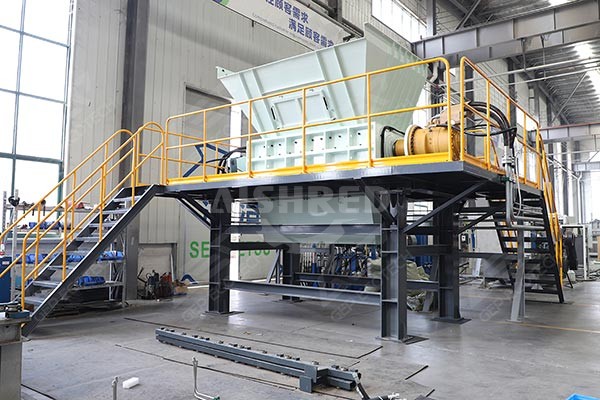
In the end-of-life vehicle shell recycling line, the relationship between the shredder and hammer crusher is not simply “coarse shredding + fine crushing”, but the preceding stage creates processable working conditions for the subsequent stage: the shredder converts irregular, hollow, large-size vehicle shells into uniform materials with controlled size, so that hammer crusher can complete dissociation and balling within an efficient range. Without this coordination, the capacity of hammer crusher will be repeatedly dragged down by feed fluctuations and blockages, and the actual throughput of the whole line often fails to reach the design value.
Customized Configuration: Matching Project Conditions rather than Applying a Fixed Template
Different projects differ obviously in vehicle shell sources, dismantling depth, target products and site conditions, and there is no "universal configuration" for the production line. The model selection of the shredder and hammer crusher, and the process combination of separation units, all need to be determined according to specific project conditions. GEP ECOTECH can provide customized solutions from single-machine selection to complete-line integration according to the customer's processing scale, incoming material characteristics, finished product purity, local environmental compliance requirements and site layout. Welcome to contact us to discuss configuration ideas based on actual project conditions.