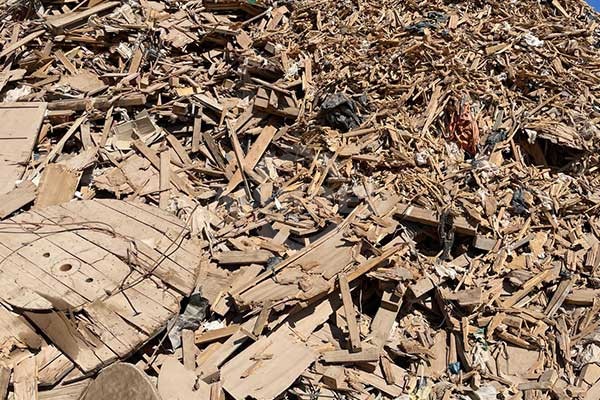
During construction, formwork removal, and renovation projects, large quantities of waste wood are generated, including wooden formwork, plywood, waste wood blocks, and other construction wood waste. These materials are often large and irregular in shape, and may contain residual nails, screws, and other metal contaminants.
Simply storing this waste can take up significant space and make transportation and subsequent recycling more difficult.
As a result, many waste wood recycling operations use shredding, crushing, screening, and magnetic separation to process large pieces of waste wood into smaller wood chips or fuel feedstock, creating better conditions for further recycling
So, what equipment is suitable for shredding waste wooden formwork, plywood, bamboo plywood, and waste wood blocks?
Recommended Equipment: GD Series Double-Shaft Shredder
For waste wooden formwork, plywood, bamboo plywood, waste wood blocks, and other construction wood waste, GEP ECOTECH recommends the GD Series Double-Shaft Shredder for primary size reduction.
The GD Series offers multiple models with processing capacities ranging from 0.2–50 t/h and output sizes of approximately 50–300 mm. The equipment can be configured according to the material characteristics and processing requirements of each project.
The GD Series uses a low-speed, high-torque, dual-shaft shearing design. The two shafts rotate in opposite directions, using cutting, tearing, and compression forces to break down large pieces of wood waste into smaller sizes.
Compared with conventional high-speed grinding methods, a double-shaft shredder is better suited to large, bulky, and irregularly shaped construction wood waste.
A typical process is:
Waste wooden formwork / plywood / waste wood → GD Double-Shaft Shredder → Shredded Wood
If the primary goal is to reduce the volume of bulky wood waste, perform coarse shredding, or prepare the material for subsequent processing, a GD Series double-shaft shredder can simplify the front-end treatment process.
What If the Waste Wood Contains Nails?
Waste wooden formwork, plywood, and wood blocks may contain residual nails, screws, and other metal components.
If the shredded wood is intended for use as biomass fuel, wood chips, or alternative fuel feedstock, removing ferrous contaminants may be necessary.
A magnetic separator can be installed downstream of the shredder:
Waste Wood → GD Double-Shaft Shredder → Conveyor → Magnetic Separator → Shredded Wood
After shredding, nails, screws, and other ferrous metal contaminants can be separated from the shredded wood using a magnetic separator.
This can improve the purity of the processed wood and reduce the risk of metal contaminants entering downstream equipment.
What If a Smaller Wood Output Size Is Required?
It is important to note that a double-shaft shredder is primarily designed for coarse shredding and front-end size reduction.
If the final product requires a smaller and more uniform particle size, a double-shaft shredder alone may not be sufficient.
In this case, a two-stage shredding and crushing system can be considered:
Waste Construction Wood → GD Double-Shaft Shredder → Secondary Fine Shredder/Crusher → Screening → Finished Product
The first-stage GD double-shaft shredder handles large pieces of formwork, plywood, and wood blocks, reducing them to a smaller size.
The secondary size-reduction equipment then further reduces the particle size, while a screen helps control the final output size.
How to Select the Right GD Double-Shaft Shredder?
The main factors include:
- Material type
- Maximum feed size
- Required capacity
- Target output size
- Nail/screw content
- Final application
GEP ECOTECH can recommend the appropriate GD double-shaft shredder based on your material and processing requirements.