By the end of 2025, an environmental technology company in Egypt put a production line into operation. Its mission was clear: separate combustibles from construction waste and turn them into alternative fuel. The output of 3-5 tons per hour is not huge, but this project is worth paying attention to because it solves three tricky challenges in light fraction waste processing with a very streamlined process—and behind this is precisely the victory of systematic thinking.
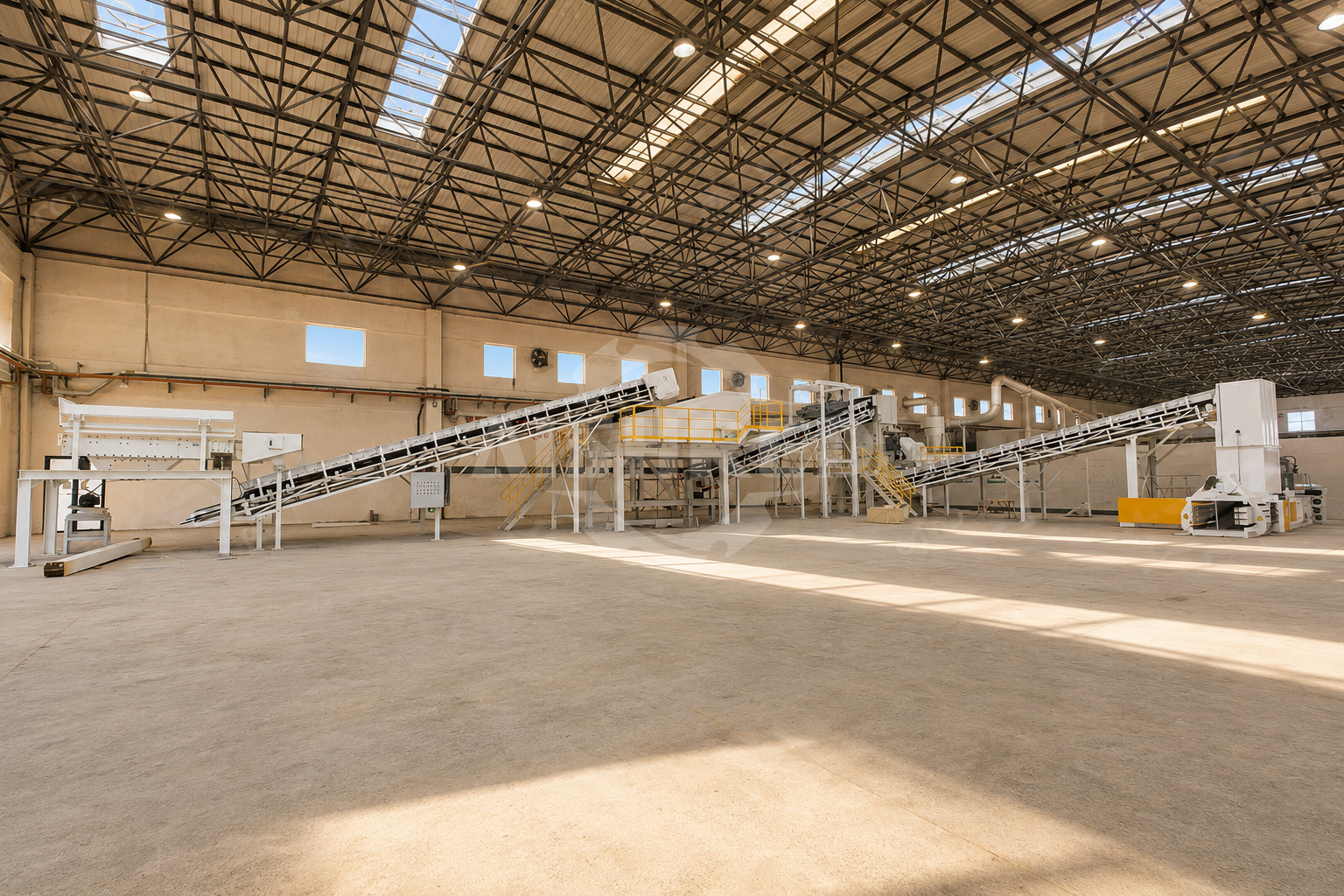
What did this project do?—Process Breakdown
First, look at the design logic of this production line. It has only five main stages:
Vibrating feeding → Bounce screening → Magnetic separation → Single-shaft fine shredding → Baling & shaping
Compared to the "all-in-one" production lines in the industry that often involve a dozen or more processes, this solution is remarkably restrained. But it is precisely this restraint that reflects a deep understanding of the material characteristics.
| Stage | Equipment | Core Function | Problem Solved |
|---|---|---|---|
| 1 | Vibrating Feeder | Even material distribution | Prevents load fluctuations in downstream equipment caused by uneven feeding |
| 2 | Flip Flow Screen | Separation of combustibles from inerts | Removes bricks, glass, gypsum board |
| 3 | Magnetic Separator | Removal of ferrous metals | Protects cutting tools from being damaged by screws/nails |
| 4 | Single-shaft Shredder | Fine shredding to suitable size | Converts mixed materials into uniform 30-50mm particles |
| 5 | Baler | Compression and shaping | Increases bulk density for easy storage, transport, and combustion |
The customer's own feedback speaks volumes: "The process design has a clear logic, no unnecessary steps, and the equipment selection is stable and durable." Translated, this means: every piece of equipment is solving a specific problem—there is no "equipment for the sake of equipment."
Treating light fraction construction waste is a "reverse manufacturing" process—breaking down mixed waste into usable resources. There are no shortcuts, and no single "miracle machine" can do it all.
The projects that succeed commercially don't rely on flashy equipment specs, but on the coherent logic of the entire production line. This waste-to-fuel project in Egypt, built with simple equipment, proves a key point:
Systematic thinking isn't a luxury—it's essential. When every machine plays its role and every step serves the goal, "waste to fuel" becomes not just a slogan, but a profitable reality.