Profitability in the scrap tire recycling industry depends on one core principle: matching your machinery configuration to your local feed stock and downstream buyers. Buying oversized equipment drains your capital, while under-specifying leads to constant downtime.
4 Practical Decision Points Before Investing in Tire Recycling Equipment
Before investing in tire recycling equipment, map out your facility around these four practical decision points:
1. Define Your End Product First
Your target market dictates the entire processing line:
Tire-Derived Fuel (TDF): If you are supplying cement kilns or paper mills, you need uniform 20mm–50mm rubber chips. A primary double shaft shredder paired with screen—or a four shaft shredder—is sufficient.
Rubber Mulch & Crumb Rubber:
If your buyers are turf installers, asphalt pavers, or molded rubber manufacturers, you must go further. You will need a secondary rasper, magnetic separators, fiber removal system, and fine granulators to achieve 99.9% wire-free rubber granules (1mm–5mm).
2. Match Machinery to Tire Sizes (PCR, TBR, OTR)
Not all scrap tires process the same way. Passenger car tires (PCR) can be fed directly into a standard tire shredding line.
However, commercial truck and bus radials (TBR) require a hydraulic tire de-beader first to pull out thick steel bead wires before shredding.
If you plan to process heavy mining Off-The-Road (OTR) tires, you must budget for an excavator-mounted shear or heavy-duty OTR pre-cutter to quarter the tires first.
3. Evaluate Cutter Life and Maintenance Costs
Steel radial wires rapidly wear down inferior blades. When comparing equipment suppliers, ask about blade metallurgy (such as imported CrNiMo alloy steel), shaft torque, and whether worn cutter teeth can be hard-faced and rebuilt rather than completely replaced. Predictable per-ton wear costs are what keep your margins healthy.
4. Plan for Space, Power, and Dust Control
A commercial tire plant requires high-torque drive systems, heavy-duty conveyors, and effective dust collection to meet local environmental regulations. Ensure your supplier provides a layout tailored to your exact workshop dimensions and local voltage standards.
Build a Profitable Plant with GEP ECOTECH
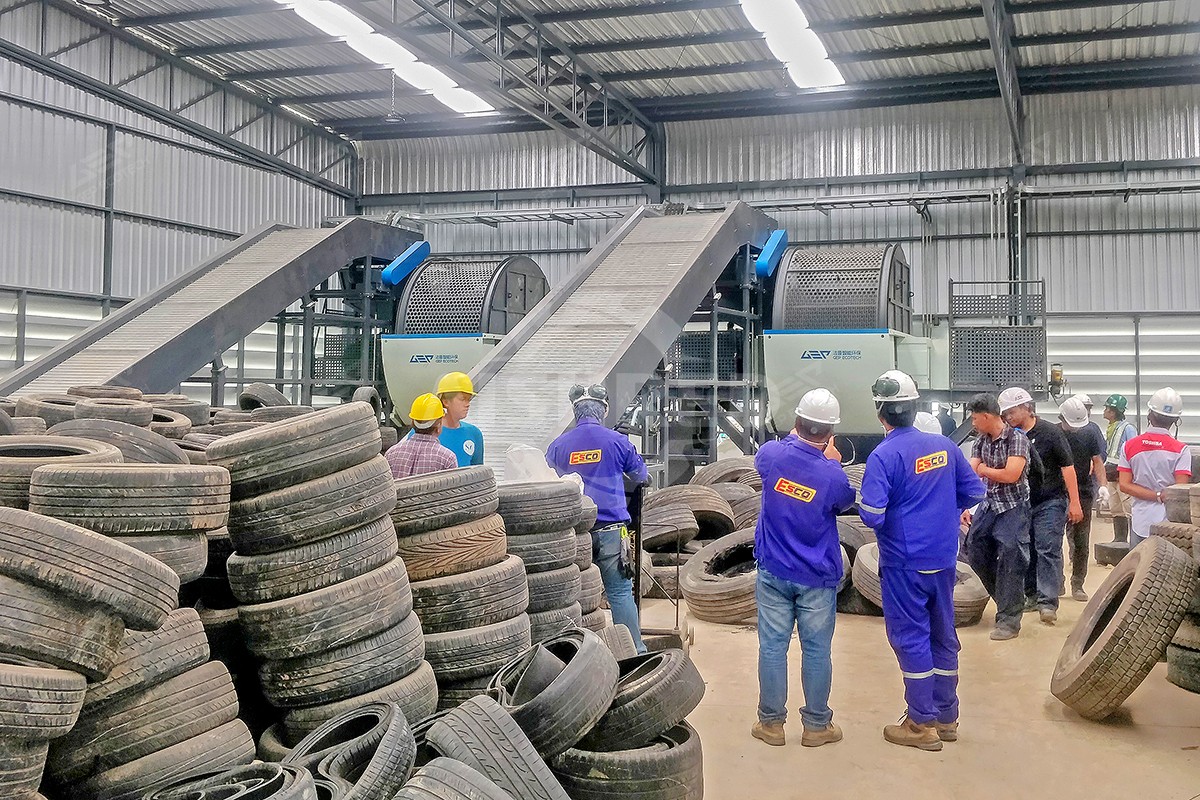
At GEP ECOTECH, we design and manufacture turnkey scrap tire recycling plants built for continuous, heavy-duty operation. From standalone de-beaders and high-torque shredders to fully automated crumb rubber lines, our engineers configure systems based on your exact hourly throughput (1 to 10+ tons/hour) and target output size.
Planning your tire recycling project? Send us your target capacity, tire types, and desired end product today for a custom plant layout and ROI-focused equipment proposal.