Synthetic rubber producers know the problem well. Off-spec SBR (styrene-butadiene rubber) and PBR (polybutadiene rubber) are compressed into bales or slabs weighing 20–35 kg, usually wrapped in a protective polyethylene film. In their wet, sticky state—common after coagulation and dewatering—these bales clog conveyors, coat dryer walls, and wrap around high-speed shredder rotors. A South American petrochemical company producing SBR and PBR is now evaluating internal recycling equipment for exactly this material: wet, tacky strips and blocks that must be crushed before re-entering the dryer inlet. The required duty is clear: low-speed, high-torque operation with no smearing, and stable performance under high moisture.
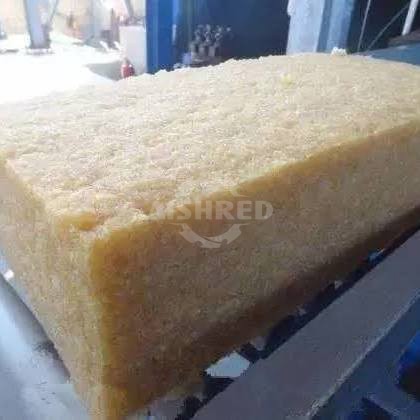
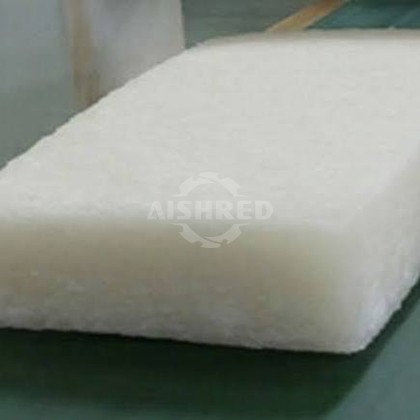
Why Conventional Shredding Fails
High-speed shredders rely on impact and rapid rotation. With wet elastomers, friction generates heat; heat makes rubber tackier; tacky rubber smears, agglomerates, and blinds screens. The result is plugging, downtime, and inconsistent particle size. The material must be fractured, not warmed and smeared. This is why low-speed, high-torque shredding is not simply an option—it is the core requirement.
The Process Route
For wet SBR/PBR, a practical flowsheet is surface conditioning/coarse shredding → drying/dewatering → final granulation. Feeding must be anti-stick: power agitators or twin-screw feeders, PTFE-coated or mirror-polished contact surfaces, and no dense-phase pneumatic conveying. Anti-tack agents such as calcium stearate, talc, or silica can help. In some cases, wet shredding under water spray controls heat and adhesion.
GEP ECOTECH: Engineered for Wet, Sticky Elastomers
This is where equipment selection becomes decisive. GEP ECOTECH, a professional manufacturer of solid waste shredding equipment, offers standard and customized solutions specifically for wet elastomers. Its GDT series double-shaft shredder—an integrated shredder with trommel screen—is designed around low-speed, high-torque operation. Instead of spinning fast and generating friction heat, the GDT rotors turn slowly and deliver high torque, shearing the bale apart. The rubber fractures; it does not soften, smear, or wrap around the shaft. This directly meets the "no smearing" requirement for wet SBR/PBR.
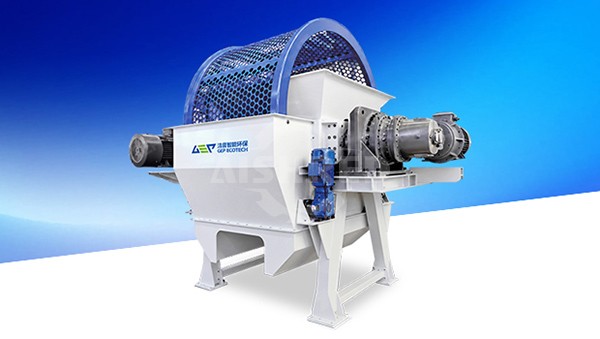
The GDT series typically handles 0.2–10 TPH and produces output around 50 mm. It can accept wet, sticky SBR/PBR strips, blocks, and bales, reducing them to a consistent chip size suitable for the next process step. For a petrochemical producer, the shredder can be placed before the dryer inlet, pre-sizing the wet rubber so the dryer receives a more uniform feed. This reduces bridging, improves drying efficiency, and protects downstream equipment. The integrated trommel screen helps control output size, while the robust double-shaft design resists shock loads and foreign objects.
GEP ECOTECH also understands that a shredder alone is not a complete solution. For high-moisture elastomers, the feed system may need a powered agitator or twin-screw feeder to break up agglomerates. Contact surfaces can be PTFE-coated or mirror-polished to prevent sticking. Anti-tack dosing and water-assisted shredding can be integrated. These are not afterthoughts; they are part of the engineering philosophy behind GEP ECOTECH's elastomer processing line.
The GDT series is widely used for tire-derived fuel (TDF) for boilers, cement kilns, and power plants, and for further fine shredding into rubber granules and powder. In SBR/PBR reclaim, it serves as the critical first stage: turning difficult wet bales into manageable, dryer-ready material. For a South American producer evaluating internal recycling of off-spec SBR and PBR, GEP ECOTECH can provide a tailored configuration—capacity, screen size, feed arrangement, and anti-stick measures—matched to the actual moisture level and stickiness of the material.
Wet, sticky SBR and PBR are not impossible to shred. They simply require a different machine logic: low speed, high torque, anti-stick design, and stable operation at high moisture. GEP ECOTECH's GDT series double-shaft shredder with integrated trommel screen delivers exactly that—transforming problematic elastomer bales into consistent 50 mm chips for drying, granulation, or reuse. For synthetic rubber producers seeking reliable in-house reclaim, the right partner is one who engineers for the material as it really is: wet, sticky, and demanding. GEP ECOTECH is that partner.